

Most teams do not set out to “build a database.” They organize important business information in a way that is easy to track, update, and report on, whether that is leads, customer requests, onboarding tasks, inventory, or internal approvals.
However, many teams run into familiar problems. Data becomes inconsistent. Duplicate records start piling up. It becomes harder to tell which version of the truth is correct. Changes take longer than expected because even minor updates can affect workflows and reporting across the organization.
These issues are common, not because teams made poor choices, but because databases require structure and planning that are often invisible at the start.
Keep reading to learn what Database Development Lifecycle is and how no-code/low-code platforms like Kintone make it easier to build reliable apps without taking on the full complexity of traditional database development.
What Is the Database Development Lifecycle?
The Database Development Lifecycle (DDLC) describes the stages a database goes through over time, from its creation to maintenance, improvement, expansion, and updates as business needs change. DDLC exists because databases are not “set and forget.” As teams grow, processes evolve, and reporting becomes more important, the underlying structure must keep pace. Without a lifecycle approach, databases can become disorganized, harder to update, and less reliable for the people who depend on them.
Database Development Lifecycle Examples
Below are examples of how the database development lifecycle shows up in day-to-day business work, without teams needing to manage the technical complexity themselves.
Example 1: Sales Team Lead Tracking
A sales team starts with a simple lead app to log contacts, assign owners, and track stages. As volume grows, they need consistency (required fields, dropdowns), cleaner data (duplicate prevention), and reporting (pipeline and conversion dashboards). In traditional database development, these updates require careful planning and technical changes.
Example 2: Ops Team Request Management
An operations team builds an app to manage internal requests. Over time, they need approvals, routing, role-based access, and clear reporting on turnaround time and bottlenecks. Traditional systems often turn these changes into IT-heavy projects.
Example 3: Scaling Workflows Across Teams
A workflow that starts in one team often spreads across departments. New requirements follow quickly, including new fields, new processes, visibility rules, and compliance needs. In traditional databases, scaling usually increases complexity and slows updates.
Why DDLC Becomes a Barrier for Business Teams?
DDLC exists to protect data quality and long-term stability, but in many organizations, it also creates friction for teams that need solutions quickly. Traditional DDLC becomes a barrier for business teams due to the following reasons:
1. Requires Specialized Expertise
Even “simple” database decisions can have long-term consequences. How records are structured, how fields connect, how data is validated, and how changes affect reporting are not always obvious. That is why database work typically requires technical knowledge that most operations, sales ops, HR ops, and finance teams were never trained on. Without that expertise, teams either avoid making improvements or rely heavily on technical support.
2. Demands Heavy Upfront Planning
Traditional database projects often require teams to define requirements early and lock in decisions before the system is even used. This sounds reasonable on paper, but it rarely works that way in business. Many teams only discover what they truly need after they start using a tool with real data. When upfront planning becomes mandatory, it slows momentum and puts pressure on teams to “get it perfect” before they have enough insight to do so.
3. Difficult to Change Once the Database is Live
After a database is in use, the stakes are higher. People rely on it daily, and any change can affect workflows, reporting, integrations, and historical data. As a result, updates that should be simple, such as adding a new field or adjusting a process, can become complex. Teams may delay improvements because they fear breaking something, even when the current setup is no longer meeting business needs.
4. Creates IT bottlenecks
In many companies, IT teams act as gatekeepers for database changes. That is not because they want to slow teams down, but because the risk of making the wrong change is real. The problem is that IT already has competing priorities, limited bandwidth, and governance requirements. So business teams often end up waiting weeks to make updates that feel urgent, which can create frustration and slow down results.
5. Slows Down Experimentation and Iteration
Modern teams need to test, learn, and improve quickly. They may want to trial a new intake process, launch a new sales motion, or change an approval workflow based on feedback. But when every adjustment requires expert support, extensive planning, and careful change management, iteration becomes expensive. The business ends up stuck with tools that no longer match how work is done.
The Shift: How Modern Platforms Change the Equation
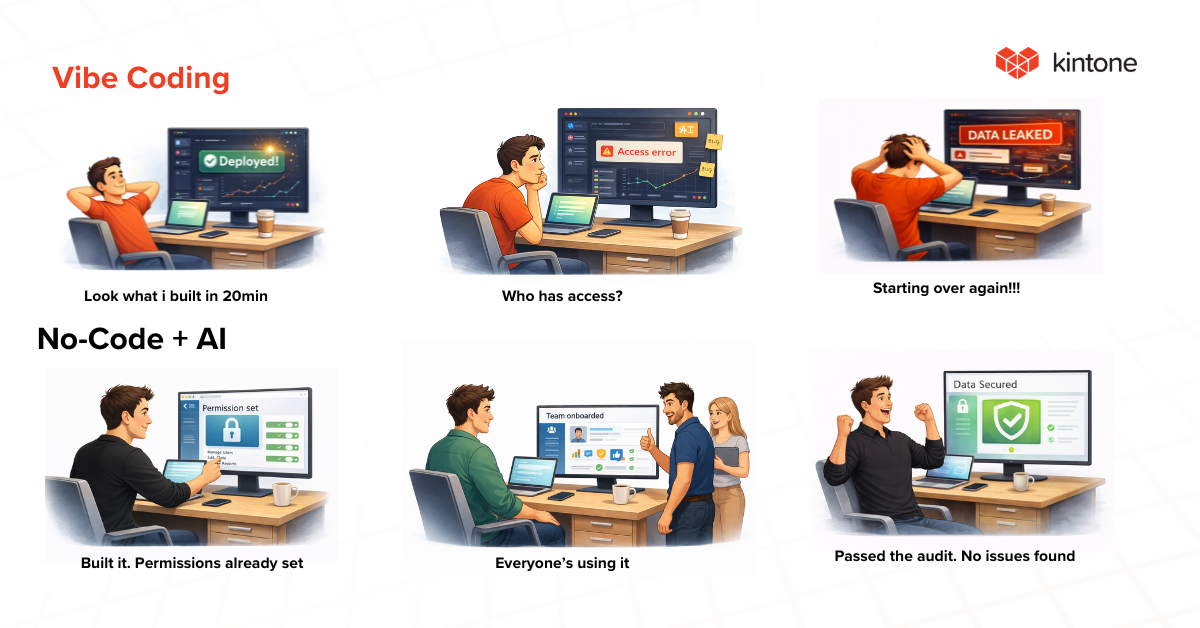
No-code and low-code platforms have changed what it means to build database-driven apps. Instead of requiring business teams to manage every stage of the database lifecycle manually, these platforms embed DDLC best practices directly into the tool. That means teams can move faster while still keeping structure, control, and long-term reliability. Here are some of the benefits of no-code platforms:
Built-in Best Practices
Rather than leaving data structures up to individual users, no-code/low-code platforms guide teams toward clean, consistent setups by default. With Kintone, teams define custom fields, required inputs, dropdowns, and connected records that help maintain data quality from day one. This reduces issues such as messy records, inconsistent naming, and duplicate entries.
Simplified Lifecycle Work
Traditional databases often require a long chain of technical steps to build and maintain, including setup, testing, deployment, and upkeep. No-code/low-code platforms reduce how much of that work business teams need to think about. Kintone allows teams to add or update fields, workflows, and reports at any point without relying on IT for every change, because the platform provides the underlying structure and supports ongoing updates.
Speed With Governance
Business teams often need flexibility, but organizations still need control. No-code platforms like Kintone enable rapid development while still enforcing governance, as access controls, permissions, and visibility rules can be built into the app from the start. That means teams can collaborate across departments, protect sensitive information, and maintain accountability, without slowing down every update through IT.
Structure Data Without the Burden
The Database Development Lifecycle is pivotal because business data must remain accurate, organized, and reliable as teams grow and processes change. Without structure, even the simplest database can become challenging to maintain, harder to trust, and expensive to fix later.
No-code and low-code platforms have made it possible to build database-driven apps with built-in structure, safer updates, and less technical overhead.
If your team wants to build databases and apps quickly without managing the full complexity of traditional database development, talk with a Kintone expert to explore a more flexible approach.


About the Author
Agbaje Feyisayo is a dynamic content marketing expert with over 10 years of experience writing high-converting content across SaaS, technology, AI, and digital transformation. With a strong background in product marketing and storytelling, Agbaje helps top-tier companies turn complex ideas into actionable content that attracts and converts leads.