


A report is approaching. The program work was done. The award requirements were documented. What staff still have to figure out is which records prove which requirement and whether the information those records contain matches what the funder is asking for.
That reconstruction work is not a deadline problem. It starts earlier: when the grant was awarded and the deliverables were defined, before a single program activity was recorded. The path between what a funder requires and the records that prove it was either established then or it was not.
When program data is connected to the grant record from the start, the data-preparation step of a report is a retrieval task. When it is not, it is a reconstruction project that begins at the deadline. The difference is determined before reporting pressure arrives.
When program information is already fragmented across disconnected records, the condition program records that cross multiple initiatives establishes, grant reporting adds a second layer of pressure to an existing problem.
What the Award Requires
The reporting deadline is not the primary unit of grant tracking. The requirement is.
A deadline tells staff when a report must be submitted. The grant requirement determines what must be demonstrated, which period applies, which program records hold the supporting evidence, who owns each obligation, what financial information is relevant, and what documentation has to remain accessible. The reporting deadline reveals whether those relationships were established before reporting began.
Federal post-award requirements under 2 CFR 200 (the Uniform Guidance) establish financial, performance, and record-retention obligations that apply according to the terms and type of Federal award. The field structure below translates those obligations into an operating model for grant tracking. The regulatory provisions establish what must be reported and retained; the record architecture is an editorial interpretation of how to hold that information in a system designed to make it retrievable. Requirements vary by award type and funder; not every grant involves every element below. The award agreement and funder guidance control.
The grant record should hold:
- Funder name, program officer, and contact information
- Award amount and approved budget categories
- Period of performance and budget period dates (terminology varies by funder; some agencies use "award period" or "project period" as alternate terms for period of performance)
- Reporting deadlines, interim and final, both narrative and financial where applicable
- Deliverables or performance measures as defined in the grant agreement, using the funder's terminology
- Compliance conditions, including allowable and restricted costs and matching requirements where applicable
- Approved amendments or changes to any of the above
- Required supporting records and documentation types
The program evidence the award requires:
- Service records, outputs, outcomes, or milestones as specified by the award. Some awards require outputs, what was done. Others require outcomes, what changed. Others require both. Use the funder's terminology rather than flattening all evidence into one category.
- Staff time allocation records where the grant requires it
- Financial information aligned to grant budget categories. Grant expenditures are typically maintained in the organization's accounting system for financial-control and reconciliation reasons. The grant record should make it possible to see financial status relative to the award, whether that information is maintained directly in the tracking system or drawn from the accounting process. The grant tracking record does not replace accounting controls or required reconciliation.
Holding both categories is not sufficient on its own. The grant record needs to point directly to the program records that contain the required evidence, not as a note in a grant folder, but as a deliberate link that makes the program data accessible without rebuilding the path from scratch at reporting time.

How Multiple Grants Create a Coordination Problem
Managing more active grants simultaneously introduces several distinct coordination failures, each with a different mechanism.
The requirement-to-data gap. A grant agreement specifies deliverables or performance measures. The program then has to collect information that maps back to those requirements. If that link is not established when the grant begins, if the grant record and the program data structure are not deliberately matched, staff may reach the reporting period with program data that does not answer the funder's question. The simpler version of this problem is not that requirements drift over time. It is that the data model never mapped to the funder's requirement in the first place.
The reporting-definition problem. Different awards can require different performance measures, definitions, reporting formats, and evidence, even when the underlying program work is similar. Federal reporting requirements establish that performance reports must relate accomplishments to the goals and objectives of each specific award, so measures are award-defined rather than standardized across funders. A practitioner example published by the Grant Professionals Association illustrates what this means in practice: a funder's "people served" framing may not represent the activity an organization is tracking, creating a gap between the data collected and the data the funder requires. A number that satisfies one award's reporting requirement may not satisfy another's, even when the program work is the same. Organizations managing multiple active grants need to maintain separate data-collection structures for requirements that appear similar but are defined differently by each funder.
Seeing what is due across all active awards. When grants are tracked individually, in separate folders, spreadsheets, or records without a common view, producing answers to basic portfolio questions requires opening each record separately. Which reports are due this month? Which grants are in their final performance quarter? Which deliverables do not yet have supporting evidence? Which awards have approved amendments that changed the original requirements? As the number of active grants grows, that review requires more manual work to produce the same picture.
The ownership gap. A grant record that does not name an internal owner for each reporting obligation has documented a deadline without assigning accountability. Program staff, finance staff, grants staff, and leadership may each hold different pieces of the required information. Without explicit ownership at the requirement level, staff may reach a reporting period having assumed someone else was tracking something nobody was.
Before the Next Report Is Due
These questions should be answerable without assembling information from multiple sources. If they are not, staff are rebuilding relationships between records during reporting rather than retrieving them.
- What does this award require us to report?
- Which period does the current report cover?
- Which program records contain the supporting evidence for each requirement?
- Who owns each unfinished reporting obligation?
- Where does the relevant financial information come from, and who reconciles it?
- Have any award terms changed since the grant was awarded?
- Where are the required supporting records, and could another staff member locate them?
- Are there measures this funder defines differently from other active awards?
One unanswered question does not suggest that software is required. Repeated inability to answer these questions across multiple active grants, particularly questions 3, 7, and 8, suggests that staff are rebuilding relationships between records at reporting time rather than retrieving them. That points to a coordination gap, not a deadline problem.
When a Spreadsheet May Still Be Enough
A spreadsheet may remain adequate when active awards are few, one person owns most administration, evidence comes from a small number of records, reporting requirements are simple, and few people need to update grant status.
The limitation appears when staff must repeatedly reconcile the same information across grants, programs, reporting periods, owners, evidence sources, financial records, and supporting documentation. That is not a question of how many grants an organization manages. There is no threshold that applies universally. The question is whether the same relationships between records have to be rebuilt each reporting cycle. If the answer is yes, the overhead is not a one-time cost. Each reporting cycle requires the same reconciliation again.

What LiveWell Colorado Shows About the Upstream Data Condition
LiveWell Colorado, a nonprofit committed to reducing obesity in Colorado, manages several programs, including the HEAL (Healthy Eating and Active Living) Cities and Towns Campaign, which tracks policy adoption by municipalities, and Double Up Food Bucks, which supports SNAP participants through farmer's markets and retail sites.
Before Kintone, LiveWell's information existed in silos. Data was manually shared between departments. Staff duplicated work other departments had already done. There was no visibility into geographic or focus-area overlap across programs.
After organizing program information in Kintone, LiveWell's Evaluation and Learning Manager Claire Siemer could run regional reports across programs to assess impact and improve campaign strategies. "We can now easily pull graphs and reports to show how our flagship programs are performing in different metros," Siemer said, "which makes measuring our impact and including that information in grant writing much easier."
What LiveWell demonstrates is the prerequisite condition this article depends on: when program information is organized and retrievable, using it for funder-facing work is a different kind of task than reconstructing it from scattered records. Siemer's point is about grant writing, not post-award reporting workflow. LiveWell does not prove that a grant lifecycle management or deadline-tracking system was built in Kintone. It proves that organized program data made it easier to communicate program performance to funders.
That upstream condition is what this article's grant tracking model is designed to create before the reporting obligation arrives.
When the Problem Has Become a Record-Relationship Problem
A nonprofit may need a database structure when it must maintain relationships between awards, requirements, owners, program records, supporting documentation, status, reporting dates, and financial references, and when those relationships need to remain traceable across multiple active grants without staff rebuilding them each cycle.
That does not automatically mean a standalone grant-management platform is required. Some grant-management platforms are designed around application intake and grantmaking administration, the process of receiving and evaluating grant applications from external organizations. A nonprofit managing awards it has already received has a different operational need: linking award requirements, deadlines, program evidence, and reporting obligations so that the data-preparation step of reporting is ready before the deadline arrives. Depending on the portfolio's complexity, that need may be served by a configurable operational database that includes grant tracking as one function alongside program management, outcome reporting, and workflow.
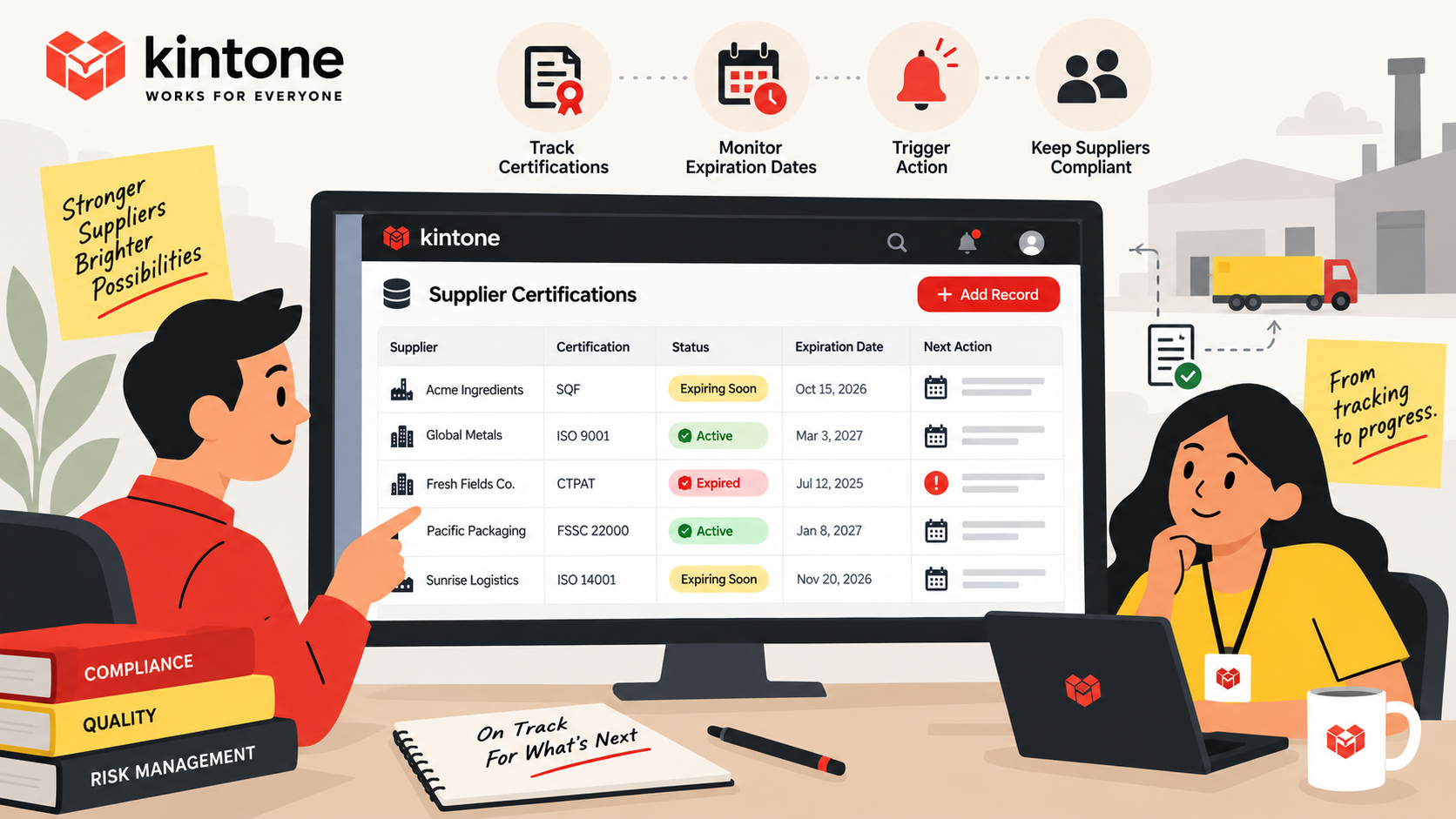
Kintone can be configured around this model. Each active award can be maintained as a grant record with the fields required to hold the award terms, reporting dates, owners, and deliverables. Related records can link the grant record to the program records where the supporting evidence lives, so staff can move from the grant requirement directly to the evidence without rebuilding the path. Filtered views and date-based notifications can bring approaching reports and obligations missing an owner or evidence into view before someone has to check each record manually. The financial information referenced in the grant record can point to the organization's accounting process rather than replacing it.
Claire Siemer built most of LiveWell's database herself without dedicated IT support, which reflects how Kintone is designed to be configured by the people who own the work. For nonprofits that want help translating their current process into a working record structure from the start, Kintone pairs each customer with a dedicated implementation expert who works with the team on the first prototype at no extra cost and stays available as the process evolves.
The organizational condition LiveWell's story illustrates, program data structured in a way that makes funder-facing retrieval possible, is what this model is designed to establish from the beginning of the award period rather than at the end of it.
Grant Reporting Starts Before the Report Is Due
A report due next month should not be the first occasion a grants manager determines which program records answer the funder's questions. That mapping belongs at the start of the award period: which requirement, which evidence source, which owner, which financial reference. When those relationships are established in the grant record from the beginning, the data-preparation step at reporting time is retrieval. When they are not, it is reconstruction.
The deadline still matters. It just stops being the moment when the organization figures out where the evidence lives.
For nonprofits managing the operational layer that connects program work to funder accountability, audit-ready reporting for grant tracking is one function in a broader system. For the cross-program data foundation that makes individual grant records useful.
Map One of Your Grant Reporting Workflows
Bring one active grant and the reporting process your team uses today. A Kintone expert can help you map the requirements, reporting dates, owners, program records, and supporting evidence involved, then show you how that structure could work in Kintone.


About the Author